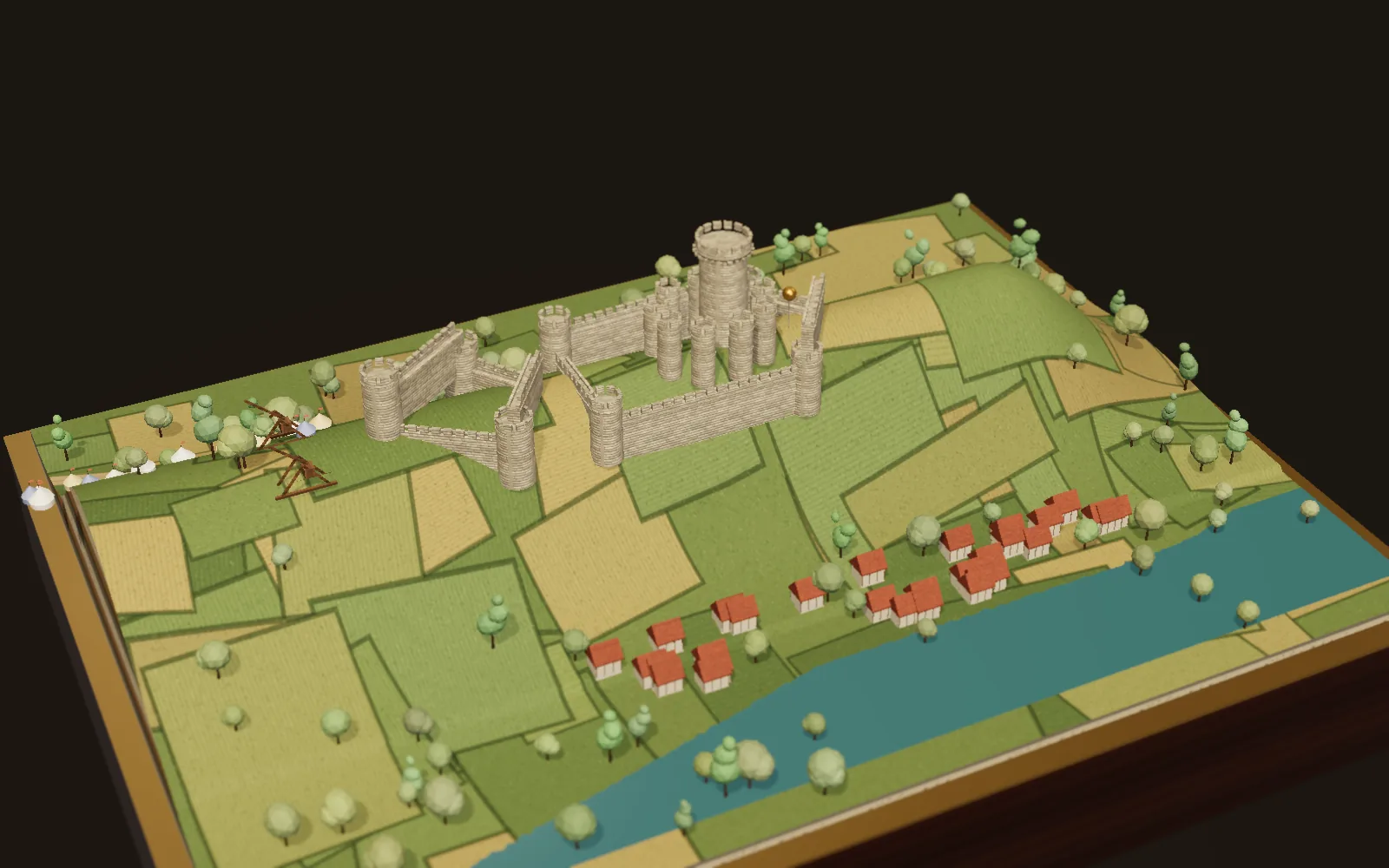
Château Gaillard stands on a chalk spur high above the Seine, guarding the road from Paris to Rouen. Richard I of England built it at great speed in 1196–98 to defend Normandy against the French king. It had three wards in a line along the spur, each separated by deep rock-cut ditches, and an inner ward with a curious scalloped wall around a strong keep.
Richard died in 1199, and his brother John proved a poor defender of Normandy. In late summer 1203, Philip II Augustus moved against the castle. He took the fortified island and the town below, then dug lines of ditches and towers around the spur to cut the garrison off.
The constable, Roger de Lacy, sent out many of the townspeople who had taken refuge in the castle to save food. When he expelled a further group, Philip would not let them through his lines. Trapped between the two forces in winter, many died of cold and hunger before they were finally allowed to pass. The episode is one of the grimmest in the history of medieval sieges.
In February 1204 Philip attacked in earnest. His men filled the first ditch and mined a tower of the outer ward, which collapsed. In the middle ward, a small party got in through an opening in a building against the wall, according to William the Breton, a chapel. At the inner ward, the French mined the wall by the gate (one account says a counter-mine dug by the defenders weakened it further), and the last defenders were overwhelmed on 6 March 1204.
Only about 140 to 160 men were captured alive. With its keystone gone, Normandy fell fast: Rouen surrendered in June 1204, ending almost 140 years of rule by English kings who were also dukes of Normandy.
What is uncertain
- The famous story that the French crawled in up a latrine chute is a later retelling; the chief contemporary source, William the Breton, describes men entering by a window or opening of the chapel, which some writers place near a latrine.
- The numbers of non-combatants expelled are uncertain; figures in modern accounts range from several hundred to more than a thousand.
- The count of prisoners differs slightly between sources, usually given as between about 20 and 36 knights and some 120 other soldiers.
Why it mattered
Château Gaillard showed that even the most advanced design could fall if no relief army came. It is also a classic example of defence in depth: Philip had to take three wards one after another, using mining, assault and surprise in turn. Its loss reshaped the map of France.