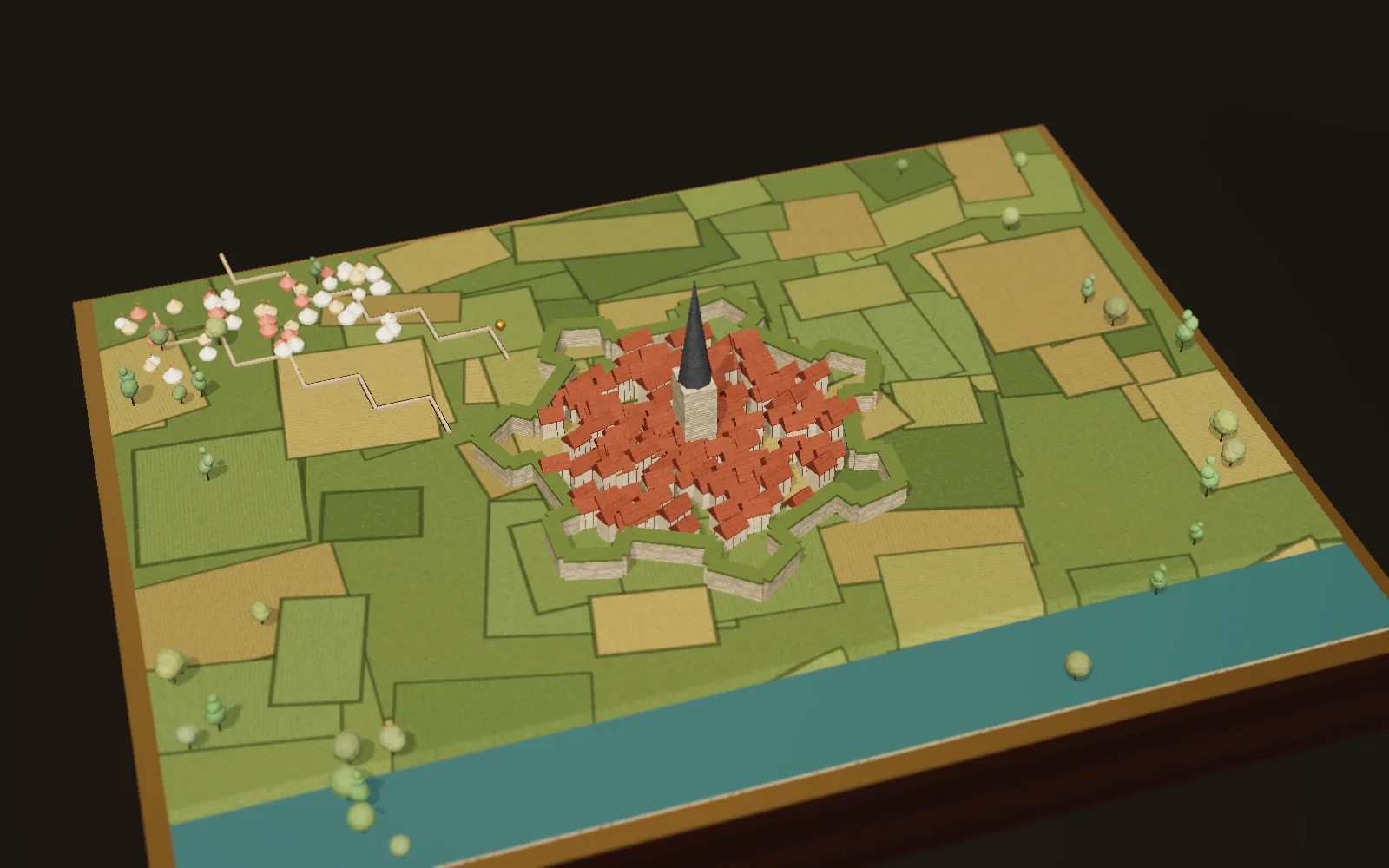
In July 1683 a large Ottoman army reached Vienna, capital of the Habsburg emperor. Emperor Leopold I had left the city; its defence fell to Count Starhemberg, with a garrison of roughly 11,000–16,000 soldiers plus several thousand armed citizens and volunteers. The city was ringed by a modern bastioned enceinte with ravelins, a wide ditch and a glacis. The suburbs outside were burned to clear the field of fire.
The Ottomans were short of heavy siege guns, so they relied on trenches and mines. They dug zigzag approaches towards two bastions and the ravelin between them, then tunnelled under the defences and blew them up with gunpowder. The defenders dug counter-mines, fought in the tunnels and repaired each breach with new earthworks behind it.
By early September the walls were badly damaged and the garrison, weakened by dysentery and losses, was close to breaking. But the Ottomans had been too slow. A relief army of imperial, Polish and German troops gathered and marched over the wooded hills of the Wienerwald to the north-west.
On 12 September the relief army attacked from the Kahlenberg heights. After a day of hard fighting, a great cavalry charge, led by the Polish winged hussars, broke the Ottoman lines. Kara Mustafa fled, the siege collapsed and the city was saved.
What is uncertain
- Army sizes vary widely: the Ottoman force is estimated at roughly 90,000 to 150,000 including non-combatants, the relief army at about 65,000 to 80,000.
- Popular stories that the croissant or Viennese coffee houses were invented to celebrate the victory are later legends without good evidence.
Why it mattered
Vienna 1683 was a textbook siege of the bastion age, fought with trenches, mines and counter-mines, and it shows that even a damaged artillery fortress could buy enough time for relief. The Ottoman defeat began a long war that ended with the Treaty of Karlowitz in 1699 and large Habsburg gains in Hungary.